
Prudential Financial
Designing clearer digital experiences for complex financial decisions.
Senior Product Designer
UX/UI Design · UX Research · Usability Testing · Data Analysis

The Job
As a Senior UX/UI Designer at Prudential Financial, I helped improve digital experiences across the company's web ecosystem.
My work focused on understanding customer needs, identifying friction within key journeys, and translating those insights into experiences that were clearer, more accessible, and easier to navigate.
I worked across the full design process—from research and journey analysis through wireframing, prototyping, usability testing, and high-fidelity design—while partnering closely with product, development, content, Journey Management, compliance, and other stakeholders.

The Overview
Financial decisions are complex. The digital experience shouldn't be.
Prudential's digital ecosystem serves customers navigating some of the most consequential decisions in their financial lives.
The challenge was not simply to make individual screens look better. It was to make the experience easier to understand, easier to navigate, and more useful at the moments that mattered.
My role was to bring a user-centered perspective to these experiences while balancing business objectives, customer expectations, accessibility, brand consistency, technical constraints, and regulatory requirements.
That meant looking beyond individual interfaces and considering the broader journey—where users were coming from, what they needed to accomplish, and what might prevent them from moving forward.

The Needs
The opportunity was to reduce friction across the customer journey.
The work centered around several interconnected needs:
Understand the customer
Identify customer behaviors, expectations, pain points, and unmet needs through research, customer panels, usability testing, and behavioral data.
Clarify the experience
Simplify complex flows and information so users could better understand their options and confidently determine what to do next.
Connect business and user needs
Translate customer insights into design decisions that supported Journey Management priorities, business objectives, and measurable outcomes.
Create with intention
Develop responsive, accessible experiences that remained consistent with Prudential's visual language and design standards.
Validate before committing
Use prototypes and usability testing to identify friction early, challenge assumptions, and refine the experience before development.

The Approach
Research informed the direction. Design made it tangible. Testing helped us refine it.
Rather than treating UX as a linear process, I approached each initiative as an ongoing cycle of understanding, exploring, validating, and refining.
01 — Understand
I started by bringing together the available evidence.
This included user research, customer panels, usability testing, stakeholder conversations, analytics, and existing journey insights.
The goal was to understand not only what users were doing, but where the experience was creating uncertainty or friction.
02 — Explore
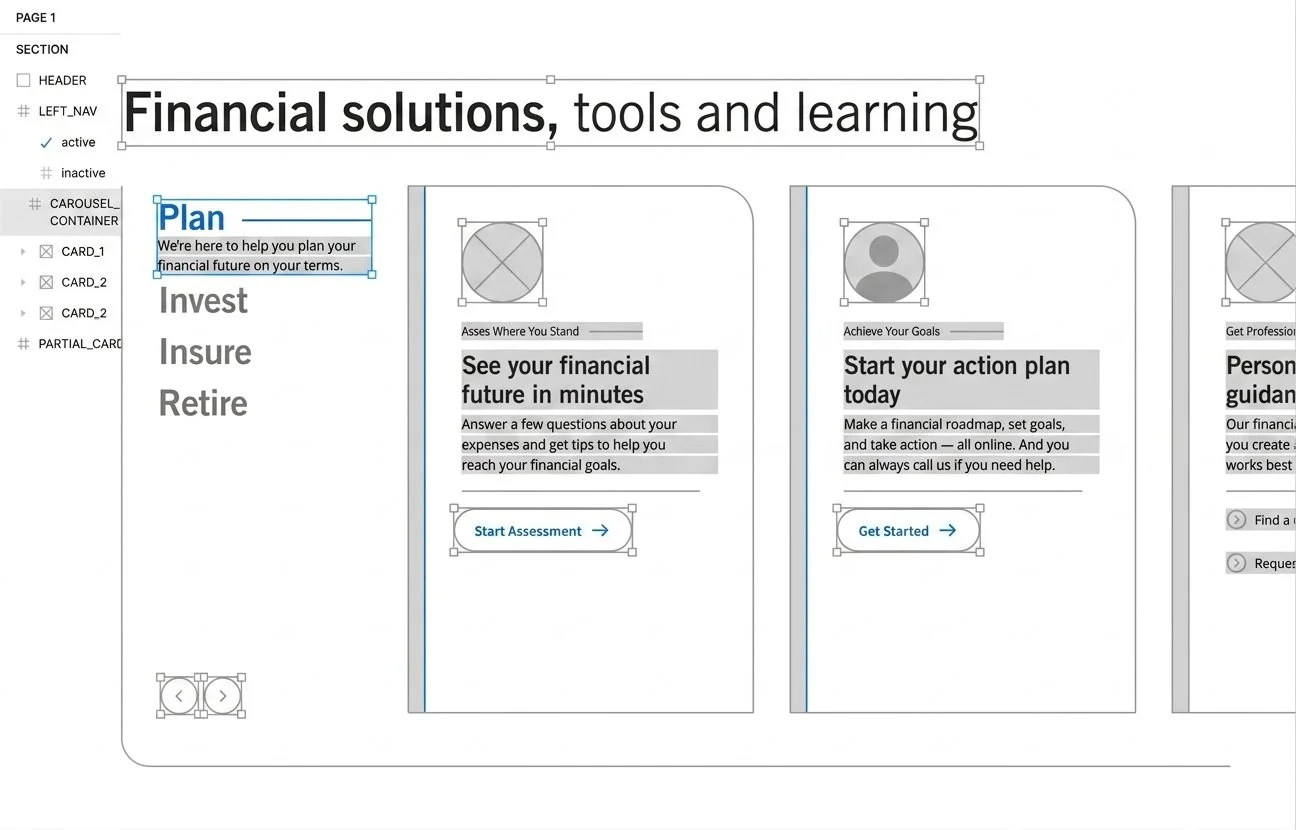
Insights were translated into possible directions through user flows, wireframes, prototypes, and interface explorations.
Early concepts gave the team something tangible to react to and helped surface questions before they became expensive development decisions.
03 — Validate
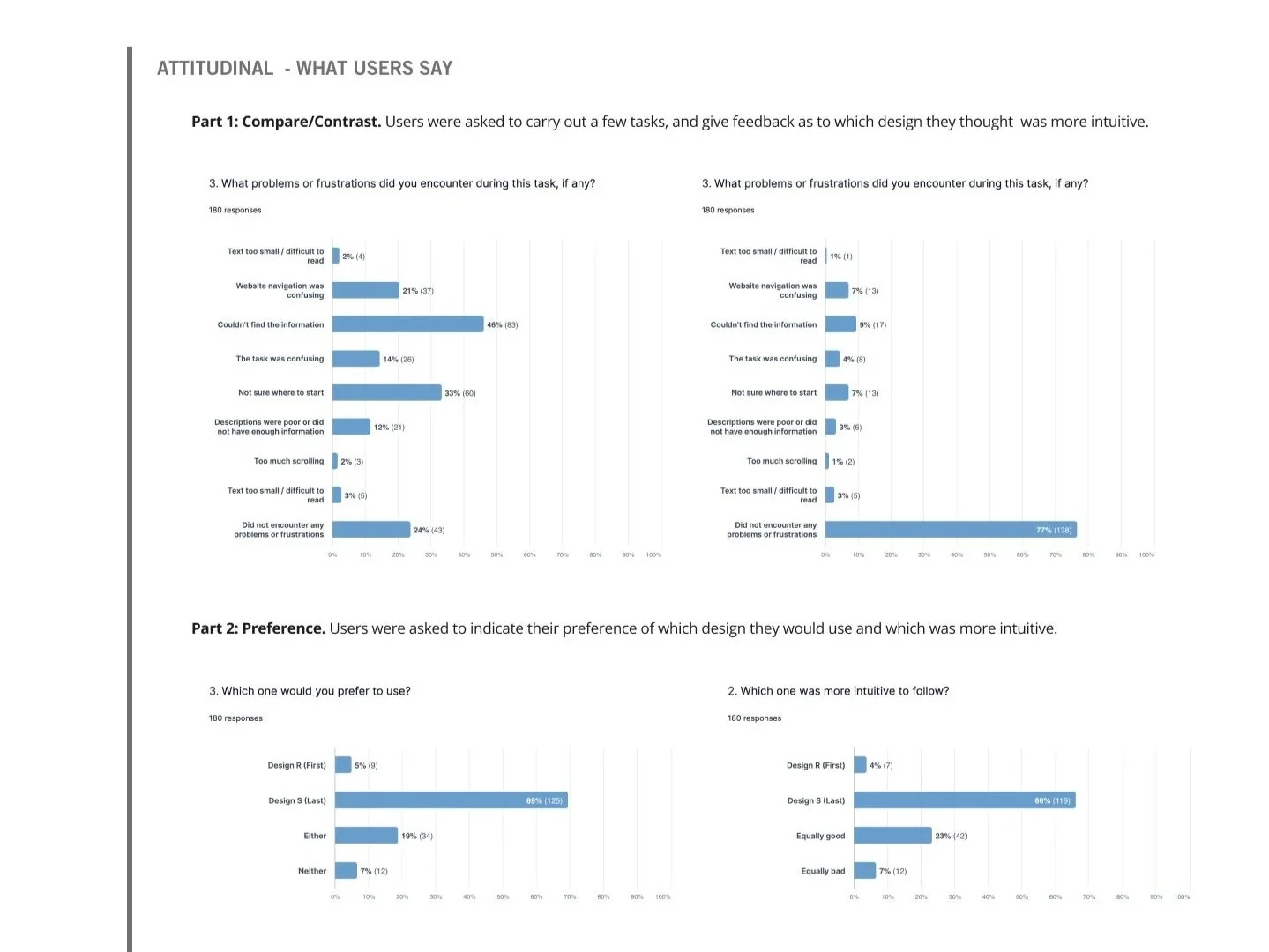
Usability testing provided an opportunity to test assumptions with real users.
I conducted both moderated and unmoderated testing, analyzed findings, and translated the results into actionable recommendations.
Research readouts were also used to communicate findings to stakeholders and help align teams around the rationale behind design decisions.


04 — Refine
The strongest directions were developed into responsive, high-fidelity experiences.
Design decisions were refined alongside product, development, content, Journey Management, compliance, and other stakeholders to ensure the final experience could work within both customer and organizational realities.

The Research
Good design decisions start with better questions.
Research was an ongoing part of the work rather than a single phase at the beginning of a project.
Customer panels, usability testing, stakeholder input, and behavioral data each provided a different perspective on the experience.
Together, these inputs helped reveal patterns that were difficult to see from the interface alone.
Turning findings into direction
Research readouts became an important bridge between UX and the broader organization.
They helped communicate what users were experiencing, why certain problems mattered, and where the design could have the greatest impact.
This made research useful beyond the immediate design team. Findings could inform conversations with Journey Management, content, compliance, leadership, and other partners involved in shaping the customer experience.

The result was not simply more information—it was greater clarity around what to design and why.
The Ideation
From early concepts to experiences that could be tested.
Once the opportunity was understood, I translated the findings into flows, wireframes, and interaction concepts.
Exploration happened across desktop and mobile simultaneously, allowing the experience to remain consistent while accounting for the different behaviors and constraints of each platform.
Rather than jumping immediately into polished screens, early design work helped establish hierarchy, flow, content relationships, and interaction patterns first.
The Refinement
Turning direction into a usable, scalable experience.
Once a direction was established, I developed the experience into a high-fidelity flow.
Stakeholder objectives and Journey Management priorities helped establish the broader structure, while research and testing provided the customer perspective needed to refine individual interactions.
This stage brought together the details that make an experience work in practice:
Information hierarchy
Interaction patterns
Responsive behavior
Accessibility
Visual consistency
Content relationships
Component and design-system considerations
Every screen had to work as part of a larger journey.
The goal was not simply to produce polished interfaces. It was to create a cohesive experience that could support users from one decision point to the next.


The Result
Creating digital experiences with greater clarity, confidence, and purpose.
My work at Prudential contributed to a broader effort to make digital experiences more useful and customer-centered.
Across the initiatives I supported, the work brought together research, strategy, interaction design, visual design, testing, accessibility, and cross-functional collaboration to create experiences grounded in real customer needs.
The result was a more intentional approach to designing within a complex financial ecosystem—one that balanced customer expectations with business priorities and the realities of an enterprise organization.
The Conclusion
Bring a customer-centered perspective to complex digital experiences.
My role was to help Prudential create better digital experiences by connecting customer insight with thoughtful, practical design.
That meant researching the problem, defining the opportunity, exploring solutions, validating decisions, and working collaboratively to bring the experience to life.
The work reinforced something I bring to every complex product environment:
Good UX is not about adding more to an experience. It's about making the right things clearer, more useful, and easier to act on.